
Project Background
In 2019, the Allegheny County Airport Authority (ACAA) launched a public bid process to find an on-site power solution for Pittsburgh International Airport (PIT). The push came after a string of highly publicized airport power outages worldwide, incidents that stranded thousands of passengers and disrupted hundreds of flights. ACAA leadership recognized that PIT needed an independent energy solution to guarantee uninterrupted operations, no matter what happened on the regional grid.
The ACAA set four goals for the project:
- Establish world-class reliability
- Save money through cost-efficient energy service
- Use locally produced energy resources and generate regional economic activity
- Demonstrate innovation for the region and community
The Solution
Liberty Power Innovations (formerly IMG Energy Solutions) and its project partners won the bid with a combined natural gas and solar microgrid designed to insulate PIT from grid disruption entirely.
What is a Microgrid?
A microgrid is a localized power system that works like a small, self-contained energy ecosystem, with a single connection to the utility grid. It can operate as an energy island, fully disconnected and self-sufficient, or as a source of power that gets exported back to the grid. A typical microgrid combines generation resources, like natural gas and renewables, with a defined group of consumers it serves. Microgrids are most often used where consistent, high-reliability power isn’t optional: hospitals, schools, military installations, and increasingly, critical transportation infrastructure like airports.
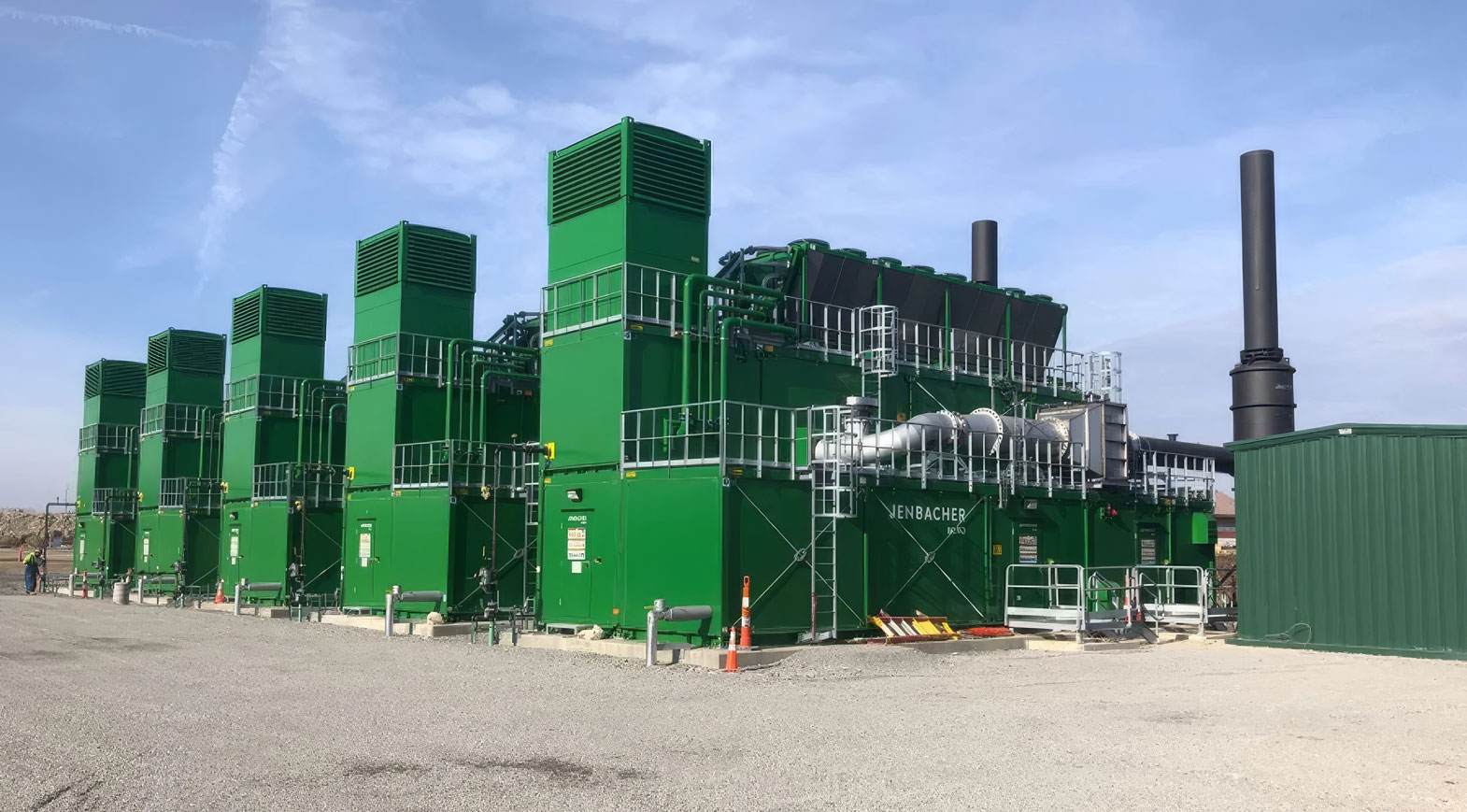
The PIT airport system pairs five Jenbacher Type 6 natural gas engines, delivering about 21.65 MW of generation capacity, with a solar array of nearly 10,000 panels spread across eight acres. Together, these resources form a first-of-its-kind system sized to meet PIT’s everyday load while serving the airfield, terminals, an on-site hotel, and fuel facilities, with the flexibility to run fully independent of the utility grid when needed.
In July 2021, PIT became the first major airport in the world to run entirely on on-site natural gas and solar power, a milestone that has since drawn global industry recognition and multiple awards for resiliency and sustainability.
Why LPI?
Drawing on deep experience designing and operating distributed energy systems, LPI and its partners determined that combining Jenbacher Type 6 engines with solar generation would deliver the best balance of reliability, flexibility, efficiency, and long-term economic value for PIT.
The Backbone
Jenbacher Type 6 engines are the foundation of mission-critical infrastructure like PIT’s microgrid. These natural gas engines are operationally flexible, with strong fuel efficiency and fast-start systems that let operators scale power up or down to match site needs while maintaining a compact, low-emission footprint. Combined with low infrastructure requirements and strong fuel efficiency, the engines deliver a cost profile that beats both the utility grid and competing generation technologies.
The Guardrails
Mission-critical facilities demand the highest levels of security, redundancy, and oversight. To meet that bar, LPI worked with outside cybersecurity and controls experts to build a proprietary microgrid control and security system, combining automated controls with 24/7 oversight from trained operators. The system prioritizes power delivery to PIT’s mission-critical functions, keeping operations stable even if equipment fails or power is suddenly lost, while maintaining a managed, parallel connection with the utility grid. Because the system is designed to always generate slightly more power than the airport needs, building in redundancy for grid-failure scenarios, PIT has been able to reliably export about 18% of the power it produces back to the grid, turning that built-in redundancy into a secondary revenue stream.
Efficiency
Each Jenbacher generator is equipped with a selective catalytic reduction (SCR) system that significantly cuts pollutants including NOx, CO, volatile organic compounds (VOCs), and formaldehyde. Treating exhaust with urea achieves a 94% reduction in NOx emissions. These controls are effective enough that the facility operates under a minor source air quality permit. The engines run on carefully filtered pipeline gas, supplied in part by five natural gas wells on the airport property, require no external water input, and use self-contained oil tanks that automatically replenish as needed. The result is a system built for both resource efficiency and minimal personnel overhead.
The Redundancy
Independence is the core design principle behind LPI’s mission-critical microgrids. The control system automatically disconnects from the grid the moment it detects an abnormality, and the plant is built with one more Jenbacher engine than would be strictly necessary to carry peak airport load while fully independent. Under normal conditions, that means a surplus of two engines, enough that the system stays fully redundant even while one engine is offline for maintenance.
As a further safeguard, LPI’s load-shedding protocols automatically take non-critical airport functions offline in a worst-case, loss-of-generation scenario, preserving power for mission-critical systems. And with black-start capability built into the system, the microgrid can restart itself from a complete outage without any outside power, bringing it back to independent operation from a cold start.
Outcomes
Since beginning commercial operation in 2021, the PIT microgrid has:
- Generated more than 460,000 MWh of electricity
- Met 99.8% of the airport’s total electrical load, with the balance drawn from the grid only during strictly managed periods
- Exported approximately 18% of total generation back to PJM, creating an ongoing secondary revenue stream managed by LPI’s asset management team across real-time and future power markets
- PIT saved more than $1 million annually in utility costs
- Exceeded average availability benchmarks for reciprocating internal combustion engine (RICE) systems, under the continuous management of LPI’s onsite and remote Operations and Maintenance teams
The project has earned global recognition as a model for airport resiliency and sustainability, positioning PIT and the broader Pittsburgh region as a proof point for what energy innovation in critical infrastructure can look like. It’s also part of a broader energy vision at PIT, which is now exploring on-site sustainable aviation fuel and hydrogen production as next steps in that same trajectory.